Monday, October 10, 2011

America


I saw this image in a magazine, or part of it. The ad in the magazine had a room full of couches, throw pillows, lamps and end tables, and behind it all was this wall. I saw the flag in it immediately. I reminded me of the encaustic white flags of Jasper Johns. I knew I wanted to paint it. I love the texture of the brick, the warmth of the ocher and sienna leaking out behind the white paint. I love how the paint attempts to "sanitize" the brick, to make it look new or renewed. But really the texture is louder than the paint. I love the wall and the window that looks out into nothing behind the wall, as if all the substance is in the wall and everything else is just window dressing. I want to paint this painting again and again, trying to recapture the different textures of each individual brick, or maybe a new painting of nothing but brick and more brick, or brick and wood panel. I want to do this partly because painting is a lot like building a brick wall, one piece at a time, slowly building up layers, layers that both reveal and conceal. I like the idea of this painting hanging on a wall somewhere, hiding the space behind it like a wall, while revealing the textures, the materials the substance of the wall that it hides, brick, mortar, paint. I call this painting America, mostly because it reminds me of how this country is built, putting up walls and tearing them down, layer after layer, century after century, one brick at a time.

Tuesday, October 4, 2011

The Dead

I think most of my “great thoughts” occur to me in the car. I don’t know if this is because I spend more time in the car than anywhere else, or if it is because I am usually alone in the car, or if my car, by virtue of being a piece of shit, rattles and jiggles me into an hypnotic state wherein I am one with the universe. Regardless, when I am in my car, the idea factory is open.

A great example of this happened to me the other day. It was morning, that much I can tell you. Most likely I was on my way home after having dropped the kids off at school. The sun was shining and it was a beautiful morning, when all of a sudden the idea hit me. I was dead.

Now before I go any further, I want to make sure you understand me. I don’t mean the “I am dying, we are all dying” I am dead. It reminds me of the line from the movie Fight Club. "Narrator: In the Tibetan philosophy, Sylvia Plath sense of the word. I know we're all dying. But you're not dying the way Chloe back there is dying." Also, I don’t mean the “what is the point, I am better off not having lived” kind of dead. What I in fact mean is that I am I dead, literally dead, not dead, walking on the earth like a zombie dead, but that I am dead, “walking around in the afterlife and I just became aware of it” kind of dead.

Now, like most ideas that I have in the car, this one is kind of far fetched. Probably due to road hypnosis and the like. But I have to admit that the idea was not an unpleasant one, and that having had my so-called “realization” I felt quite comfortable. In fact, I felt at peace.

If I am dead, and this is the afterlife, then really the afterlife isn’t all that bad. I mean, apart from the occasional ups and downs, the mood swings, the minor tantrums, the drama and such, for the most part, life, er... death, is good.

Aside from feeling liberated, it is a funny thing to think of yourself as dead, that life as we know it is really the afterlife. Clichés abound about how life is what you make it and the kingdom of heaven is now. It reminds me of movies like Jacob’s Ladder, where the main character is haunted throughout the movie, only to realize in the end that he is actually dead. By way of explanation of the plot, the movie quotes the German mystic Meister Eckhart "The only thing that burns in Hell is the part of you that won't let go of life, your memories, your attachments. They burn them all away. But they're not punishing you; they're freeing your soul. So, if you're frightened of dying and. you're holding on, you'll see devils tearing your life away. But if you've made your peace, then the devils are really angels, freeing you from the earth."

I think that this is a profound way of talking about pain that has echoes in Buddhism, namely that suffering is not caused from without, but by our attachments. The big difference of course being that Eckhart is talking about the soul’s journey after death, and the Buddha is talking about the individual’s journey through life. Though truth be told, I personally see very little difference between the two. What does it matter if we think of ourselves as alive or dead? It reminds me of the exchange between Gandalf and Pippin in the Movie the Return of the King:

Pippin: I didn't think it would end this way.
Gandalf: End? No, the journey doesn't end here. Death is just another path... One that we all must take. The grey rain-curtain of this world rolls back, and all turns to silver glass... And then you see it.
Pippin: What? Gandalf?... See what?
Gandalf: White shores... and beyond, a far green country under a swift sunrise.
Pippin: [smiling] Well, that isn't so bad.
Gandalf: [softly] No... No it isn't.

I have to admit, as I was typing my blog post on the Book of Jonah, I flinched when I admitted that I sometimes despair to the point of contemplating death as an escape, but it is equally true that I harbor a fear of death and the unknown and that those two feeling are very much at odds with one another.

I was listening to a Radiolab episode on the radio the other day as the described the action of a man who made the decision to jump off a bridge; I think it was the Golden Gate Bridge, to end his own life. Mid jump, he said, he realized he had made a terrible mistake. The announced later commented that of the twenty-four or so people out of one thousand that actually survived the same fall, almost all unanimously confirmed the same experience, namely that the desire to live was rekindled in the act of falling. I wonder, of the nine hundred and seventy-six that died, how many had the same experience but we not as lucky?

Anyway, back on point. I don’t think that I obsess about death, or that my musings on it are unnatural. Quite the contrary, the more I think about it, the less power it has over me. If I imagine myself as already dead, that I am strolling though the afterlife, death no longer seems like an option, as an escape from my suffering, nor as a thing to be afraid of. As Pippin said, “that isn’t so bad.” The torments I face are really the ones of my own making, and not the unknown that looms in the future.

I kind of like this thought, as odd as it is, a kind of Egyptian "the afterlife is a parallel of this life" kind of thing. Though without Pharaohs and Sphinxes and such. I don't believe I could walk around pretending I was dead all the time, but when I think about it, and stare out my window in to the wide world beyond, it puts a little quirky smile on my face and I chuckle to myself, and then I go on about my day.

Monday, October 3, 2011

What is this thing to you?

Is there anyone that doesn’t know the story if Jonah, particularly that part in which Jonah is swallowed by a great fish? I thought that I did. I have read the story several times in the last thirty years, and yet as we talked about the story in my adult Sunday school class last week, I found myself marveling over passages that seemed entirely new to me.

At the end of the story of Jonah, the Assyrian people repent, and turn to God, who in turn forgives them. Jonah’s response? He throws a fit. “I knew you were going to do that” he says, “ I knew you were going to forgive them. What was the point of my coming here if all you were going to do was forgive them?” He sits down outside the city and fumes.

Some people might me mystified by Jonah’s behavior. I think it is interesting that I never really took great notice of it. Probably because it was too close to home as this is where many of my conversations with God begin. “What was the point of that?” Just like Jonah I become incalcitrant. I can see myself in Jonah’s shoes. Frustrated, he is so overwhelmed with emotion that he is no longer able to talk with God. JoHe goes and sits outside the city wall in the burning desert sun and prays for death.

I am no stranger to this response. It is not uncommon for me, faced with some difficulty, or having felt some offence, to shut down the rational part of my mind. I become fixated on the swelling tide of emotions that churn within my body and I am incapable of offering defense on my own behalf. Furious at my own impotence as much as any perceived offence I may find myself acting out or saying something inappropriate that only worsens my situation. I am not above praying for release, even death, in these moments.

God’s response to Jonah is equally interesting. He causes a plant to sprout and grow overnight until it is large enough to shade Jonah. I imagine this plant like one of the trees you see in a Dr. Seuss book, long and gangly and multicolored. Jonah, the passage says, likes the plant, and enjoys the shade.

In yet another twist, God kills the plant, and here is where the story ends, or almost. Jonah becomes incensed, and God, seeing Jonah’s anger says to him “what was this plant to you? You did not plant it, you did not raise it, it was not yours, and yet when it dies you are angry. How much more are the people of this city, lost and confused, than this plant to which you owe nothing?”

The book ends on the question, and does not offer an answer. It appears as though it is the reader, and not Jonah, who is asked the question and expected to make an answer. Why are you angry? What is this thing to you?

The author is silent.

Thursday, August 18, 2011

Take my class

This year the adjunct faculty had an assignment, write a short email answering the question "What do I want my students to walk away with?" In the absence of anything else to blog about, I thought I would share my thoughts with you...

Over the years I have had the random former student email me telling me they saw this or that painting, and that they were able to identify it because of my class. However I really sincerely doubt that the majority of my students, even the best, would be able to do this within weeks of taking my class. I don't want to sound mean, thought I know it sounds jaded, but simply put, if it isn’t in their interest they are going to forget it, quickly.

This begs the question, why teach if they aren’t going to remember? To answer this question I want to share an anecdote that happened to me some years ago. As I was standing beside the copier, I was engaged in small talk with another professor from a different department. When I told him I taught Art he looked at me rather smugly and said, “So, what is Art?”

“Take my class.” I said.

The answer to this question, a question, incidentally, that opens the first paragraph of our textbook, is no small matter. Is it the work of art, the process the artist uses to create a piece, or the skill and craft of the artist themselves? Over the years I have come to believe that Art is a language, a language of the culture and the time in which it was created. To tell you what art is, I must first teach you to speak that language, understand its nuances and syntax, and then, versed in this language we can begin a cover the meaning of the question, “What is art?”

That being said, here are some of the things that I want my students to gain from my class:


1. That art is a lens though which we view culture.

2. That there is a specific language used to communicate how this lens functions.

3. That this lens will vary with time and place, and is unique to its own particular set of circumstances

4. That to use this lens we must first take of the lens of our own culture, or, as it were, peek around it as much as is possible.

5. That to learn this language, one must not only study images, but also ideas, history, other languages, and in short, other cultures.

In the end what I want to teach my students is how to approach art, I want to teach my students how to think about art, so that with this mindset, they can look at any work of art, and not just "Las Menias" or the "Arnofini Wedding Portrait", and walk away with a new found appreciation and understanding of the work that is in front of them.

Friday, August 12, 2011

Elizabeth Murray on my favorite painting


This is the American Artist Elizabeth Murray. It turns out she and I love the same painting. Actually a lot of what she says in this very short clip resonates with me. It makes me wish I had known her.


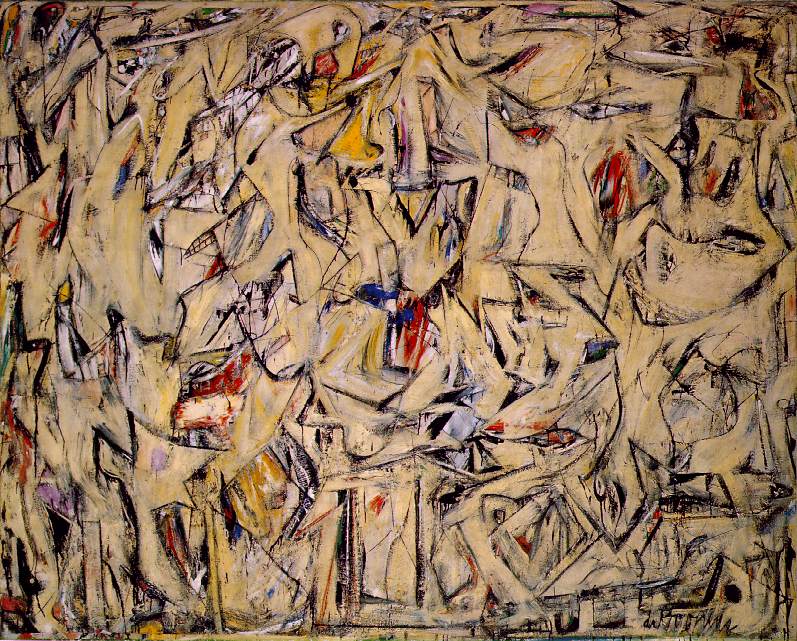
Excavation was done by William de Kooning in 1950. This painting is an example of de Kooning's complex and dense style. Like many Ab Ex artists of this time, de Kooning's painting reflects a synthesis of Cubism and Surrealism. You can claw your way though the images in this work, uncovering layer after layer of meaning (hence the title).


Thursday, August 11, 2011

Did I mention I love my therapist?

“What do you think of when you think of a higher power?”
“Honestly?” I paused giving the question its full weight. “I think of nothing.” I could see she was searching my face for some emotional response. “Not a nihilist or atheist nothing, like 'there is nothing out there' kind of nothing. Rather it is more like a 'once you are a part of the all what is the difference between being part of everything and being part of nothing'…nothing.”
“What does this nothing look like to you, then?”
“You mean am I blissed out, living with angels and harps? No, probably not. But I suspect that given the alternative, being a part of this nothing is a helluva lot better than the alternative.”
“What do you mean?”
“I mean a world full of opposites, good/bad, right/wrong, even earth/heaven. You know the idea of heaven is a little suspect, isn’t it. It is just another aspect of the same old thing. We are born, we live, we die, and then we go to heaven. Then, because we don’t know any better, or because that is the way it is, it starts all over again. I want off this cosmic merry-go-round. That is my idea of heaven.”
“So why not get off?”
“I would if I could.”
“Have you tried doing it in reverse?”
I paused and thought about this for a moment. “You had me right up until the end. What do you mean, doing it in reverse?”
“So, according to you, there is nothing, and the nothing is split into a universe of opposites.”
“Right. First there is the word, and the word is separate from the silence.”
“And then one is judged good and the other…”
“Bad.” I added with extra emphasis.
“Right, bad. And so it goes, opposites are created and values are given to each pair of opposites. One is good the other is bad.”
“I think I see what you mean.”
“So now you take it in reverse. You identify what opposites you give value judgments, and remove the values, without values there is no…”
“Difference?” I interrupt.
“Without, value judgments the differences fade, without differences, there is no opposite. In the end all you are left with is your nothing.”
“I don’t think it is as easy as that.” I add skeptically.
“Have you tried it?” She asked inquisitively.
“No.” I said matter-of-factly.
“Well then how do you know?”
“Every movement towards the divine takes an act of faith.” I say superiorly.
“Why don’t you try?” she said, patiently.
“I suppose I have nothing to lose.” I say with a bit of defeat.

Wednesday, July 27, 2011

Pantheon of Higher Powers

I flipped open an Al-Anon book this morning and the first sentence I read was “When we say higher power, initially people believe that we are speaking of a religious entity. We are not. We are speaking of a loving, caring, nurturing Power that provides us with guidance…” As I began thinking about this, I realized that, while I have always identified “Higher Power” with “God”, in truth a higher power is anything that I set over myself, a power that guides and directs me, and that while ideally this higher power is a nurturing, loving power, more often what I make my higher power is job, relationship, or love. I am easily distracted by these powers, and while I think my intentions are good, the “guidance” that I receive by chasing after them, often leaves me angry, lonely, and unfulfilled. Essentially I make all the petty, material, even mundane problems of my life that power that seizes my every thought, and I bow down to these idols with an all too frequent and familiar regularity.

Later I had the opportunity to talk about this thought with a friend. I pointed out that, the statement “Came to believe” held three solutions for overcoming my obsessions with these insignificant powers that hold so much sway over me. Recognizing them or “Came” was the first part. Recognizing that there is a force over which I am powerless is perhaps the most important part of making change.

The second, “came to” is the understanding that I have a significant role in choosing these powers and the way that they affect me. It is no accident that this or that power is able to possess my thoughts and emotions so powerfully. I am an active and willing participant in choosing what I call my higher power.

Finally, “came to believe” is the realization that while I sometimes think that I have given up hope believing that I will ever be able to do things differently, the truth is that I harbor faith that even if I am not able to do things differently, I believe that these things can and will change. I am not always able to name the source of this faith, or the object in which this faith is placed, but the fact that my desire for change exists, means that hope is not dead, and that I am willing to do whatever it takes to live my life differently.

In rereading this, so much of my thoughts seem nothing more than jargon pulled directly from countless Al-Anon meetings. I don’t know that I have made the fateful step of turning my will and my life over to some higher power that truly loves me and wants to nurture and guide me towards serenity. Instead what I am choosing to focus on is the idea that I don’t have one higher power, I have many, and that the dizzying array of higher powers are a pantheon of petty grievances, fears and insecurities that I am ready to name and turn over, because they no longer serve me, and I no longer wish to serve them.